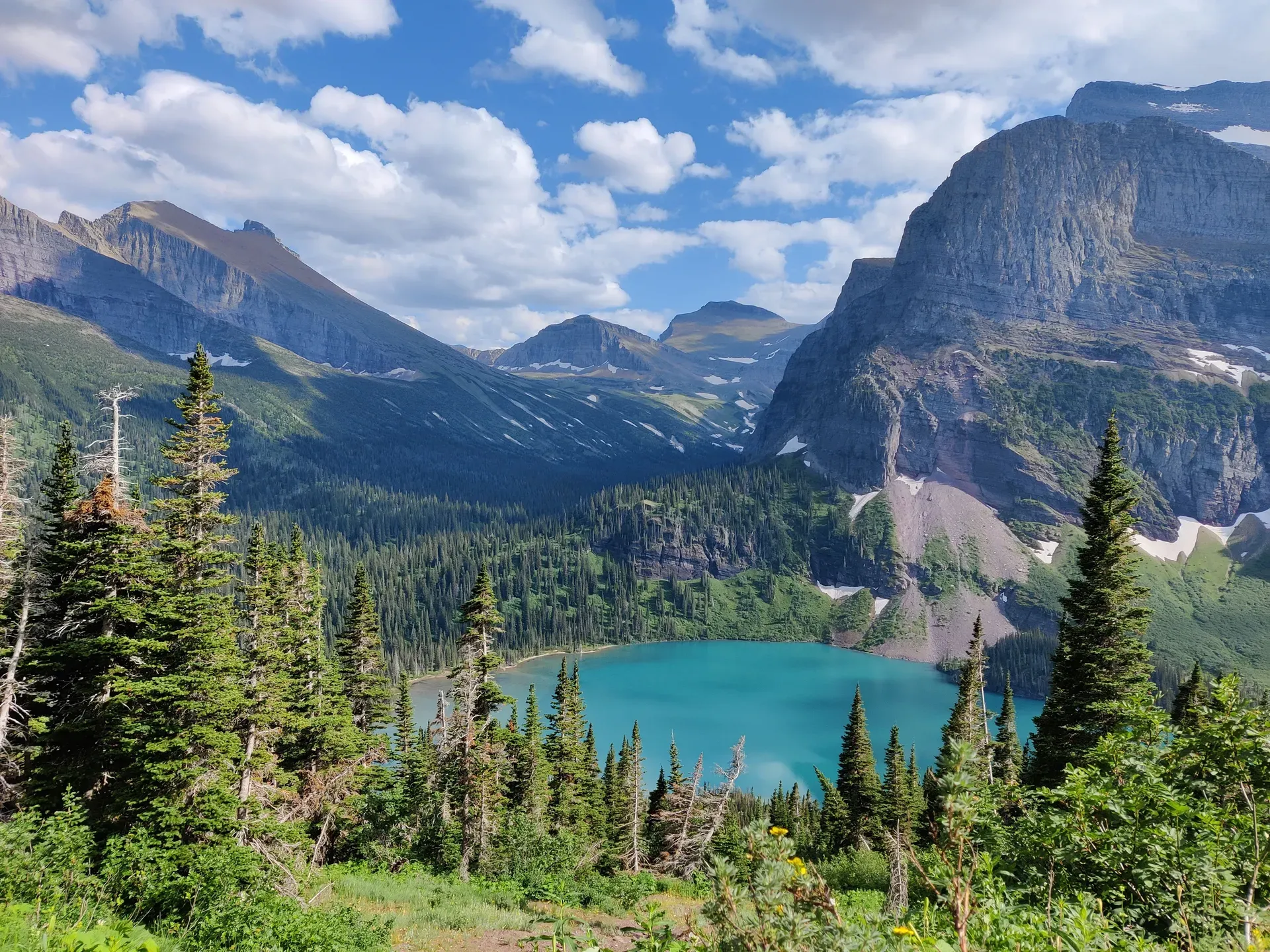
Glacier National Park covers 1,012,837 acres of the Rocky Mountains in northwestern Montana along the U.S.-Canada border. The park preserves 26 active glaciers, 762 lakes, and a largely intact temperate ecosystem.
Glacier National Park occupies 1,012,837 acres of the Rocky Mountains in northwestern Montana, directly bordering Canada's Waterton Lakes National Park. The Lewis and Livingston mountain ranges bisect the landscape from northwest to southeast, forcing the Continental Divide through the center of the park. Visitors drive the 50-mile Going-to-the-Sun Road, which climbs from dense cedar-hemlock forests near West Glacier to the 6,646-foot alpine meadows of Logan Pass. The terrain holds 762 lakes, 563 streams, and 175 named mountains.
The park protects a highly intact temperate ecosystem. Seventy-one mammal species inhabit the valleys and high ridges, including grizzly bears, gray wolves, wolverines, and mountain goats. The United Nations designated the area a Biosphere Reserve in 1976 and a World Heritage Site in 1995, recognizing its biological diversity and geological history. The 26 remaining named glaciers are actively shrinking due to climate change, altering the hydrology of the 2,865 miles of streams that flow from the high peaks.
Summer access dictates the visitor experience. Snowpack keeps the alpine sections of Going-to-the-Sun Road closed until late June or early July, restricting spring traffic to the lower elevations around Lake McDonald and St. Mary. July and August bring fully accessible trails and heavy crowds, filling parking lots at Logan Pass and Avalanche Creek before 8:00 a.m. Travelers arriving between November and April find most roads and visitor centers closed, requiring complete self-sufficiency in sub-zero conditions.
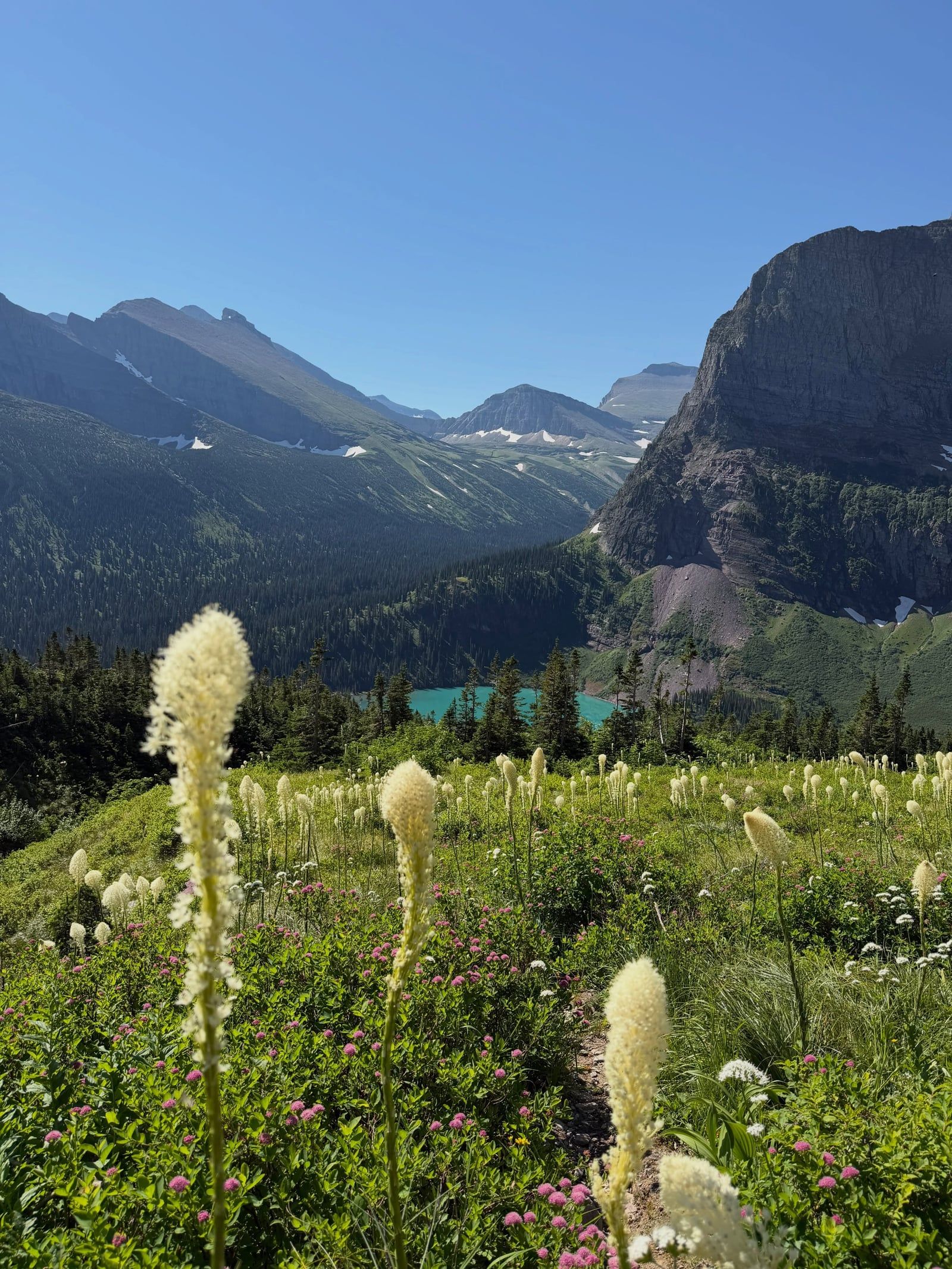
The Blackfeet, Salish, and Kootenai peoples inhabited the mountains and eastern plains for thousands of years before European arrival. These groups utilized the valleys for hunting, gathering, and seasonal migration across the Continental Divide. European trappers and explorers entered the region in the 19th century, mapping the drainages of the Flathead River. Naturalist George Bird Grinnell arrived in 1885, spending the next two decades documenting the glaciers and lobbying the federal government to protect the area from widespread mining and logging operations.
The federal government designated the region a Forest Preserve in 1900. Grinnell's continued campaign succeeded on May 11, 1910, when President William Howard Taft signed legislation establishing Glacier as the 10th national park in the United States. The Great Northern Railway subsequently built a network of Swiss-style chalets and large lodges, including the 1915 Many Glacier Hotel, to attract wealthy tourists via the Empire Builder train line. These structures established the park's early infrastructure and concentrated visitor activity around Swiftcurrent Lake and Lake McDonald. Construction on the Going-to-the-Sun Road began in 1921 to accommodate the rise of the automobile. Engineers spent 11 years blasting a 50-mile route through the cliff faces of the Garden Wall, completing the project in 1932. That same year, the United States and Canada merged Glacier and Waterton Lakes into the world's first International Peace Park.
The 1930s saw the Civilian Conservation Corps (CCC) establish camps within the park boundaries. CCC workers constructed trails, fire lookouts, and campgrounds that remain in use today. During World War II, visitation plummeted, and many of the remote backcountry chalets fell into disrepair or were destroyed. The post-war economic boom brought a surge of automobile tourists, shifting the primary mode of exploration from multi-day horseback trips to scenic drives along the Going-to-the-Sun Road corridor. Today, the National Park Service manages the wilderness while balancing preservation with access. Visitors must secure shuttle tickets through Recreation.gov to access Logan Pass during peak summer months, as parking lots routinely fill before sunrise.
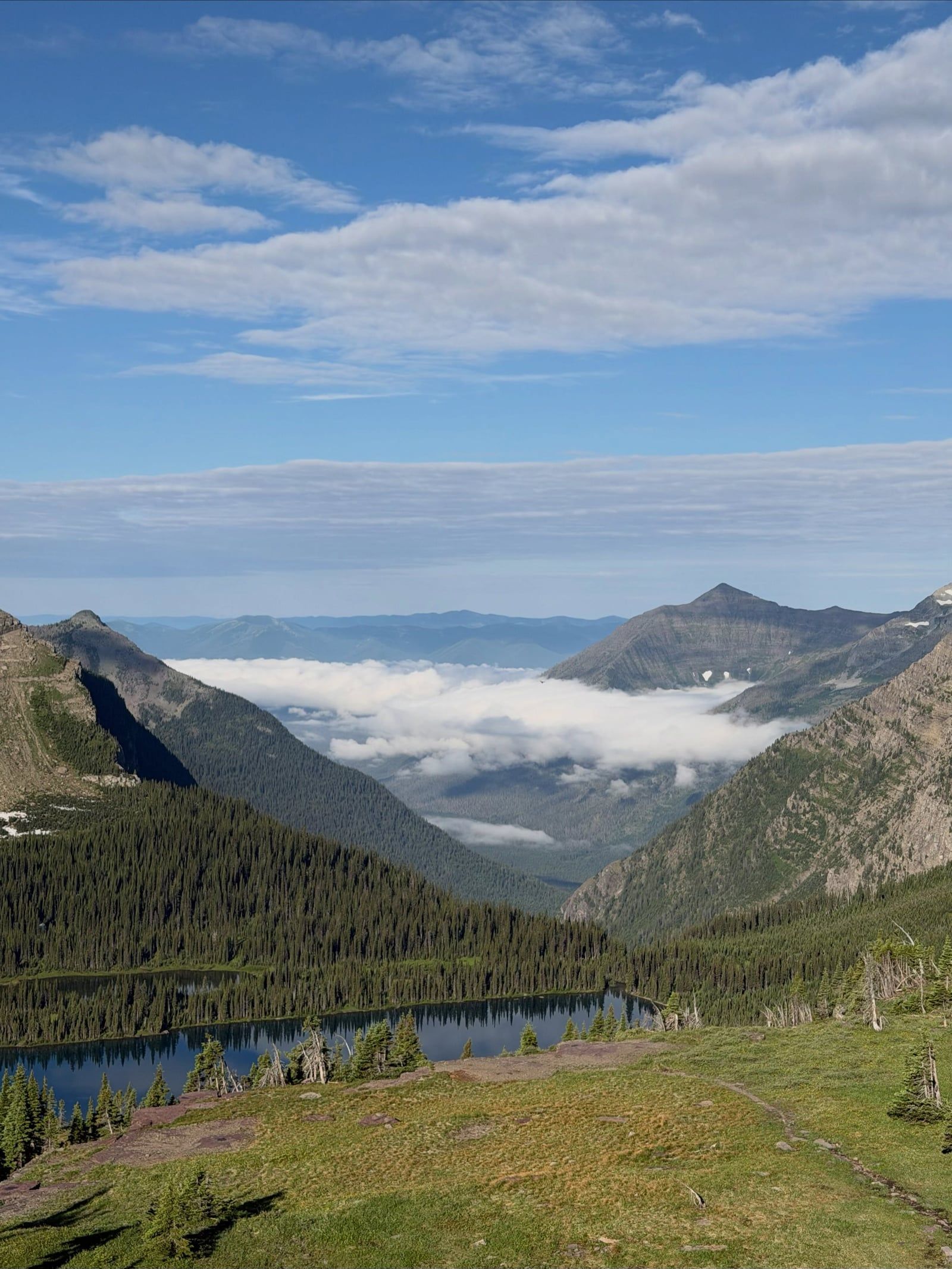
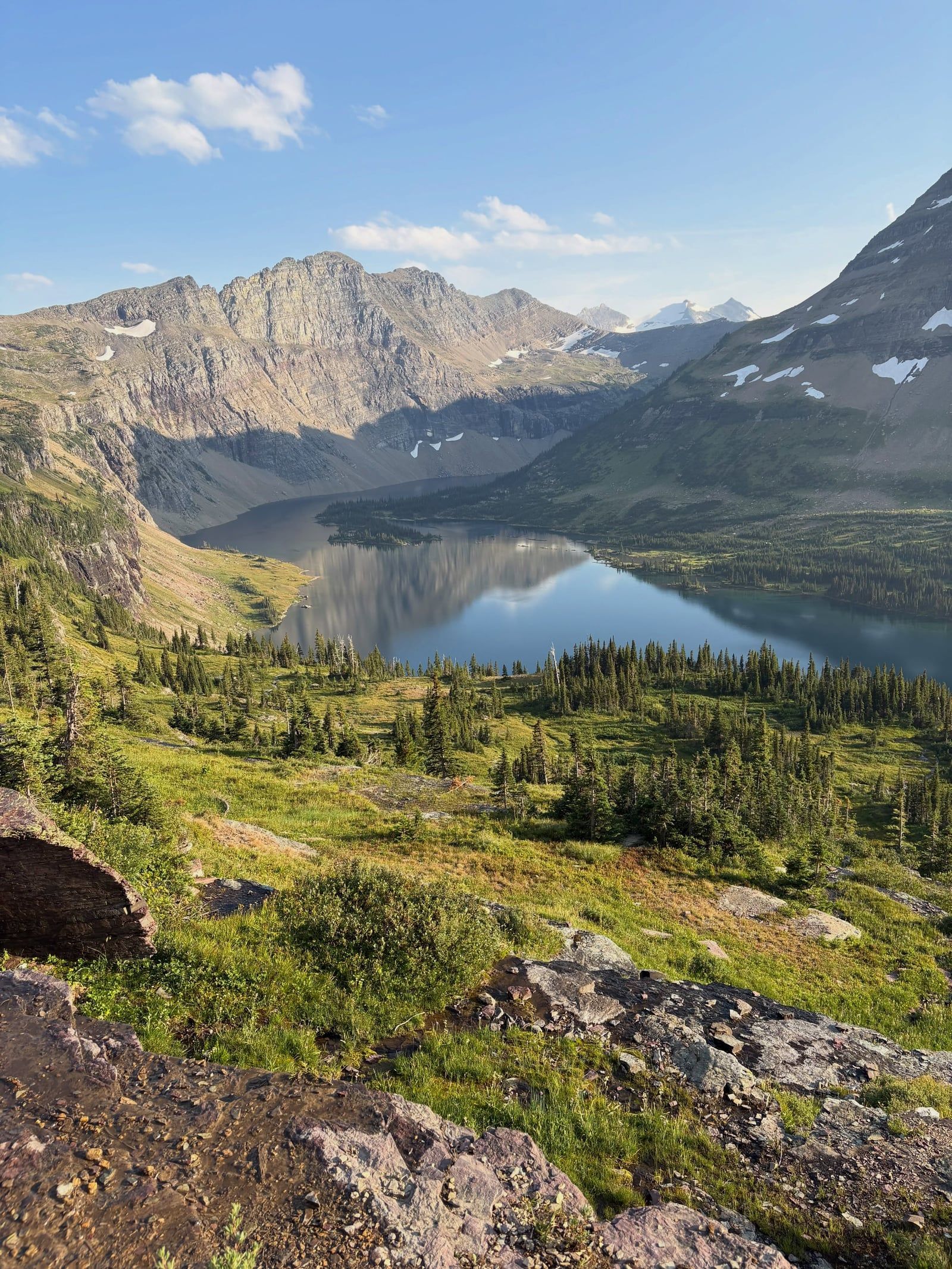
Massive ice sheets carved the park's topography during the Pleistocene epoch, leaving behind deep U-shaped valleys, sharp arêtes, and pyramidal horn peaks. Mount Cleveland rises to 10,448 feet in the northern section, the highest of the park's 175 named mountains. The rock formations consist primarily of sedimentary layers from the Belt Supergroup, visible as distinct horizontal bands of red argillite and green mudstone on the cliff faces. These ancient seabeds contain fossilized stromatolites dating back over a billion years.
Water defines the lower elevations. Lake McDonald stretches 9.4 miles long and drops 464 feet deep, filling a glacially scoured basin on the west side of the Continental Divide. The lakebed is covered in multicolored, iron-rich rounded stones clearly visible through the cold, nutrient-poor water. Higher up, the park's 26 named glaciers cling to north- and east-facing slopes. Harrison Glacier, the largest, covers approximately 1.6 million square meters. All 26 glaciers are losing mass, with meltwater feeding 563 streams that eventually drain into three different oceans.
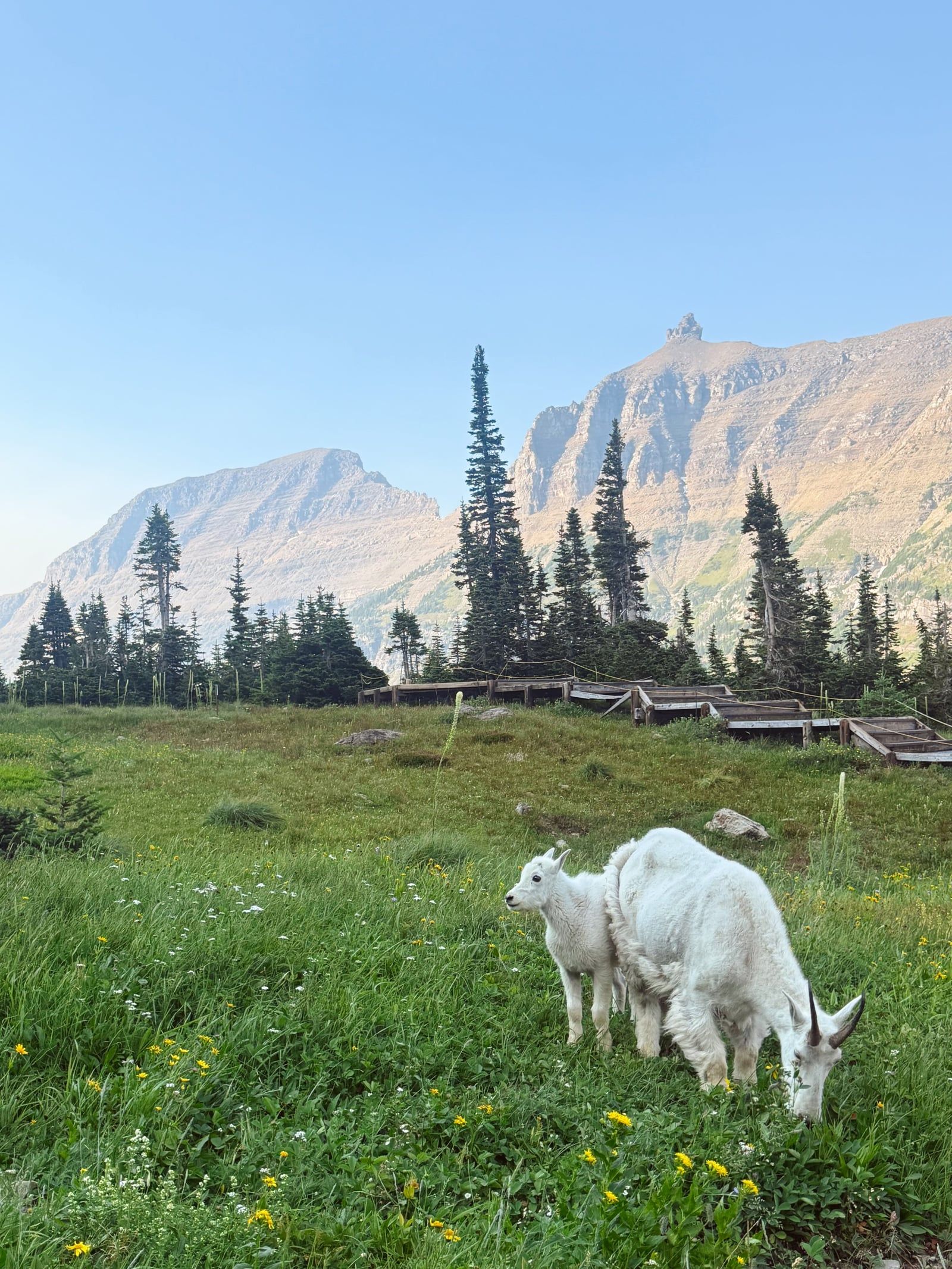
The Continental Divide creates two distinct climate zones. The western slopes receive heavy Pacific moisture, supporting dense cedar-hemlock forests and ferns along trails like Avalanche Creek. The eastern side experiences drier, windier conditions, characterized by lodgepole pine forests and open prairie grasses. Wildlife moves freely across these zones. Visitors hiking the 2.7-mile Hidden Lake Overlook trail frequently encounter mountain goats grazing in the subalpine meadows, while grizzly bears forage in the avalanche chutes of the Many Glacier valley. Hikers must carry EPA-registered bear spray and maintain a strict 100-yard distance from all bears and wolves.
The landscape holds religious and historical importance for the Blackfeet, Salish, and Kootenai tribes. The Blackfeet refer to the mountains of the eastern front as the "Backbone of the World," a site for vision quests and the gathering of traditional medicines. Chief Mountain, located on the park's eastern boundary, remains a prominent ceremonial landmark. The tribes maintain treaty rights in the region, and the nearby Blackfeet Indian Reservation in Browning operates the Museum of the Plains Indian to document the cultural history that predates the park's borders.
The 1932 formation of the Waterton-Glacier International Peace Park established a physical and political link between the United States and Canada. This designation allows visitors to cross the border on foot or by boat, demonstrating cooperative wilderness management between nations. Architecturally, the park's early buildings defined the National Park Service rustic style. The Great Northern Railway constructed lodges using massive Douglas fir logs and local stone to mimic Swiss alpine chalets. The 1915 Many Glacier Hotel still operates on the shores of Swiftcurrent Lake, maintaining its original timber-framed design. Visitors can ride historic wooden tour boats, like the DeSmet, which have navigated the park's glacial lakes since the 1920s.
The park currently has 26 named glaciers remaining, all of which are actively shrinking due to climate change.
Lake McDonald is the park's largest body of water, measuring 9.4 miles long and plunging 464 feet deep.
Glacier contains 71 mammal species and sustains a uniquely dense grizzly bear population.
Vehicles over 21 feet long or 8 feet wide are banned on the Going-to-the-Sun Road between Avalanche Creek and Rising Sun.
Glacier and Canada's Waterton Lakes form the world's first International Peace Park, established jointly in 1932.
The park does not accept cash for entrance fees; visitors must pay the $35 summer vehicle fee using a card.
Launching, landing, or operating unmanned aircraft is strictly prohibited everywhere within the park boundaries.
A private vehicle pass costs $35.00 in the summer and $25.00 in the winter (November 1 to April 30). The pass is valid for seven consecutive days. The park is entirely cashless, so all payments must be made by card.
No vehicle reservations are required for the 2026 season. The park operates a ticketed shuttle system with three-hour limited timed parking at Logan Pass. Shuttle tickets require a $1 processing fee through Recreation.gov.
The lower sections near West Glacier remain open year-round. The full 50-mile road over Logan Pass typically opens in late June or early July after snow clearing. It closes for the winter around the third Monday of October.
There are 26 named glaciers remaining in the park. All of them are shrinking in size due to climate change. Harrison Glacier is the largest, covering approximately 1.6 million square meters.
Glacier has a dense population of grizzly and black bears. Visitors must stay at least 100 yards away from bears and wolves. Hikers should travel in groups, make noise on trails, and carry EPA-approved bear spray.
July and August provide the most reliable weather and full access to the Going-to-the-Sun Road, though these months draw the heaviest crowds. June brings strong waterfalls, while September brings fall colors and fewer visitors.
Pets are prohibited on all trails, along lakeshores, and inside visitor centers and lodges. They are only allowed in developed areas like parking lots and paved overlooks. When permitted, pets must be leashed and never left unattended.
Glacier Park International Airport in Kalispell is the closest option, located 30 miles from the West Entrance. Missoula International Airport is 150 miles south. Great Falls International Airport sits 130 to 165 miles east of the park.
Amtrak's Empire Builder line stops directly at the park boundary year-round in West Glacier and Essex. It also makes seasonal stops at East Glacier Park. A paid summer shuttle connects the West Glacier depot to Lake McDonald Lodge.
No. Launching, landing, or operating unmanned aircraft is strictly prohibited everywhere within Glacier National Park. This rule is enforced year-round under National Park Service regulations.
Browse verified tours with free cancellation and instant confirmation.
Find Tours